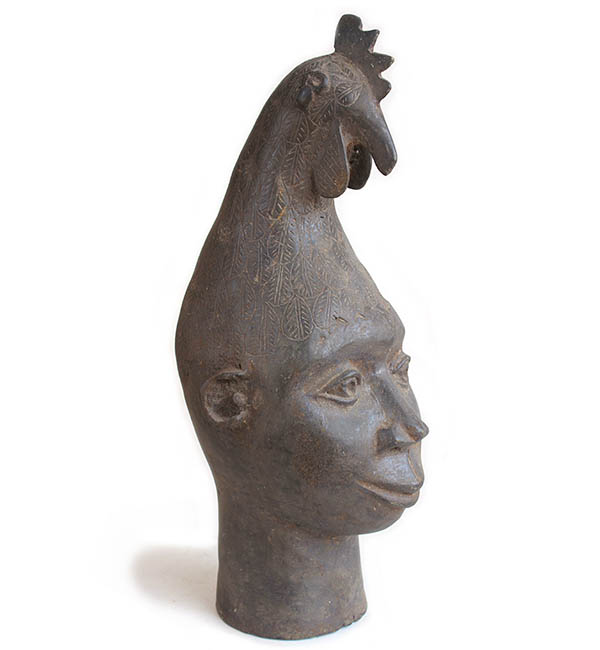
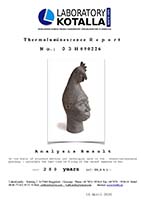
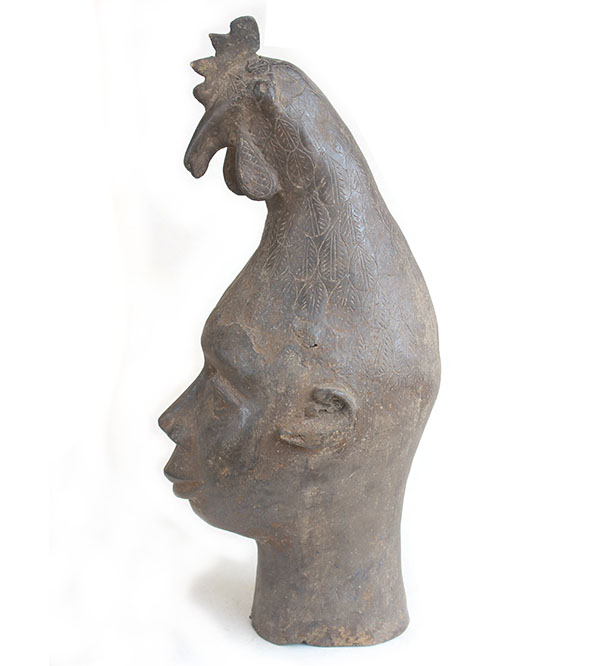
A patina that had developed slowly and evenly was the deciding factor in taking the risk of purchasing the piece and commissioning an expert appraisal. This expressive head, from which a cockerel emerges, is too unusual to be classified within art history, and the thought naturally arose that someone from more recent times had had an abstract artistic idea. However, following a TL analysis, it is clear that the head dates from around 1750.
For its age, the head is exceptionally well preserved. It shows no signs of corrosion and has no damage. Only the figure’s pupils, which are thought to be made of iron, are missing; upon examination, this suggests that the head’s age can be inferred from its weathering.
It is difficult to say what this head might be expressing. At first glance, one associates it with madness, but on closer inspection this impression fades into the background. The face has features that are atypical for Benin and southern Nigeria. The lips and nose might suggest a European person. Because it is a rooster growing out of the head, it could represent a man whose character is associated with this image. Here, too, a rather negative, derogatory thought springs to mind at first glance, but this is probably incorrect. Roosters and hens play a significant role in the mythology of southern Nigeria, and the comparison with the positive characteristics of animals leads to the belief that humans can transform into animals – which is not necessarily to be understood in a physical sense.
The only thing that is certain is that it is an expressive and valuable rarity. |