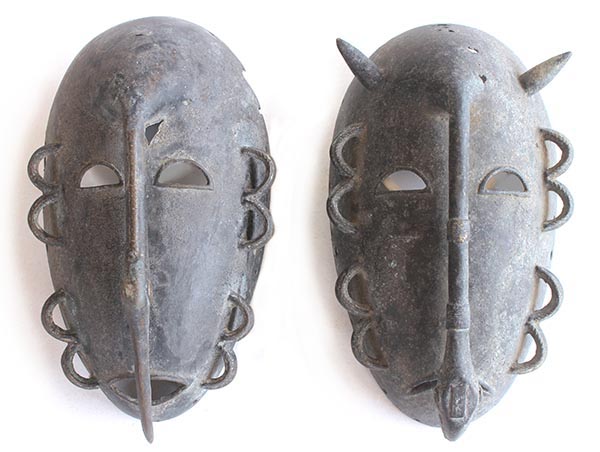
This masks, skilfully reduced in expression, came to Togo from the Ivory Coast. As has been described many times before, the assumption made by established European dealers that ‘nothing old comes out of Africa anymore’ has had an impact on various African countries. The fact that mainly fakes and replicas with fabricated information are traded further underpins this claim. There is a growing tendency to try to sell old art via Togo because, even today (2025), Lomé still has the outdated reputation of being a trading centre for traditional art in West Africa.
I do not have sufficient literature in Lomé to describe the masks ethnologically. The purchase was based on artistic and historical aspects.
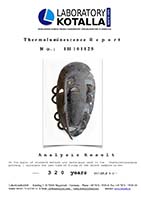
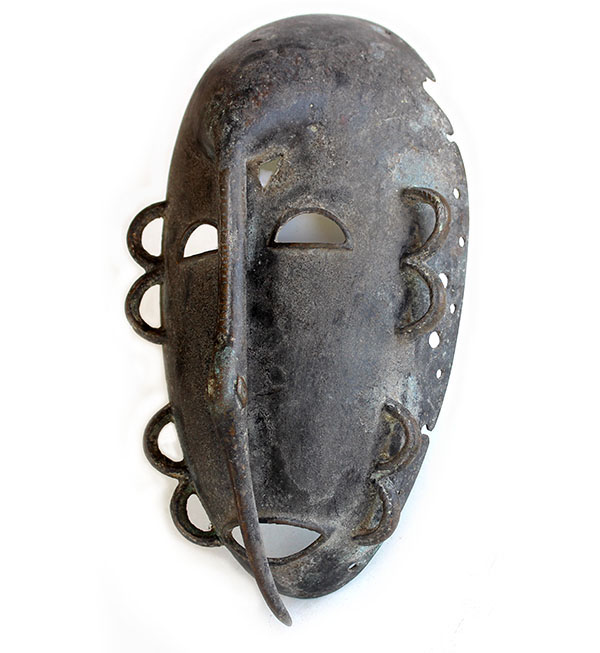
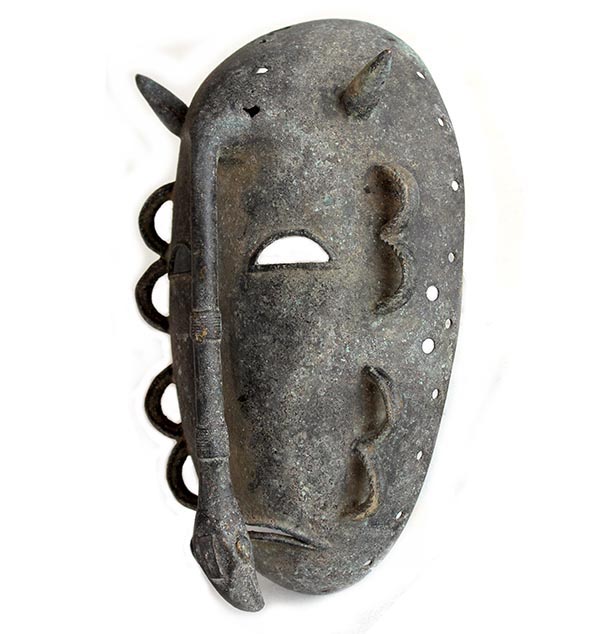
The forehead of both masks curves downwards towards the nose, which depicts a bird. I can only assume that, as in other countries, this is a somewhat abstract representation of an ibis bird. The masks were still heavily soiled, which was left as evidence of the excavation but was carefully removed by the author in order to assess the patina and corrosion. The casting of the mask with the friendly expression that I had examined still had indistinct traces of casting core residues on the inside of the forehead, which I had to sand down. During the examination in the laboratory, the metallic abrasion had to be separated from the clay core residues, which is technically possible nowadays.
At the rear edge of the mask, in the area of the holes for attaching it before performances, the friendly mask has minor damage that is insignificant for the overall impression. There is also a spot of corrosion under the forehead. |